
Western Bee Fly
Some pollinators get a better press than others but all are important in the overall puzzle that is Britain's natural world.
Today the Beebomb Bee-log takes a closer look at one of the less heralded pollinators. Where you can see them, how they are coping in our changing world and details on the fascinating, ingenious and unexpected behaviour of the Western Bee Fly.

Common Name: Western Bee Fly or Bomber Fly
Latin Name: Bombyliidae
Information: I know I say this about all the pollinators but this really is a fascinating little beast. Named as a bee fly for it's superficial resemblance to a bumblebee, it is actually a fly with one set of wings. The Western Bee Fly is often commonly called the Bomber fly. A funky nickname given to it for some very interesting behaviour it displays. Look out for the Bee fly in the early part of the summer as it can be seen in flight from March onward. It sets out early as it is looking for solitary bee nests that are being prepared and once it finds one suitable, it hovers over or just inside the entrance (often preferring hillside nests) and 'bombs' it's eggs into the bee nest before it is sealed. The larvae then hatches and becomes carnivorous, feasting on the bee larvae.
They feed on nectar and their furry bodies are efficient at collecting pollen, making them, parasitical behaviour notwithstanding, an important element to a bio-diverse environment.
Description: Making a buzzing noise in flight and with it's often yellowish marking, the Bee Fly can be mistaken at first glance for a Bumblebee. All four sub species found in the UK have a long tongue (proboscis) and most have dark front edge to their wings. See more detail and images of the different UK Bee flies here
Concern Level: Moderate
Distribution: Mainly found in the south and west


1 pack of handmade, native wildflower Beebombs. 1000s of seeds from 18 native wildflower species, mixed with local protective clay and sifted, nurturing top soil. 1 pack provides coverage for roughly 21 sq ft / 2m² of wildflower meadow.
Beebombs are a mix of annuals and perennial species, providing natural and diverse habitat. They’re specially designed to help support your local pollinators and provide a long flowering season, rich in colour and vibrancy.
Using seedballs protects the seeds from predators and provides a nurturing environment for the seeds to germinate from, making it easier for you to create the wildflower habitat Britain needs.
We use no plastic in our packaging or process and make your Beebombs in a truly sustainable and traditional way on our farm in Parley, Dorset.
Free tracked postage and packing on all orders, Dispatched same day (before 12pm) via Royal Mail Tracked 48 service, to anywhere in the UK.
Next day delivery also available.
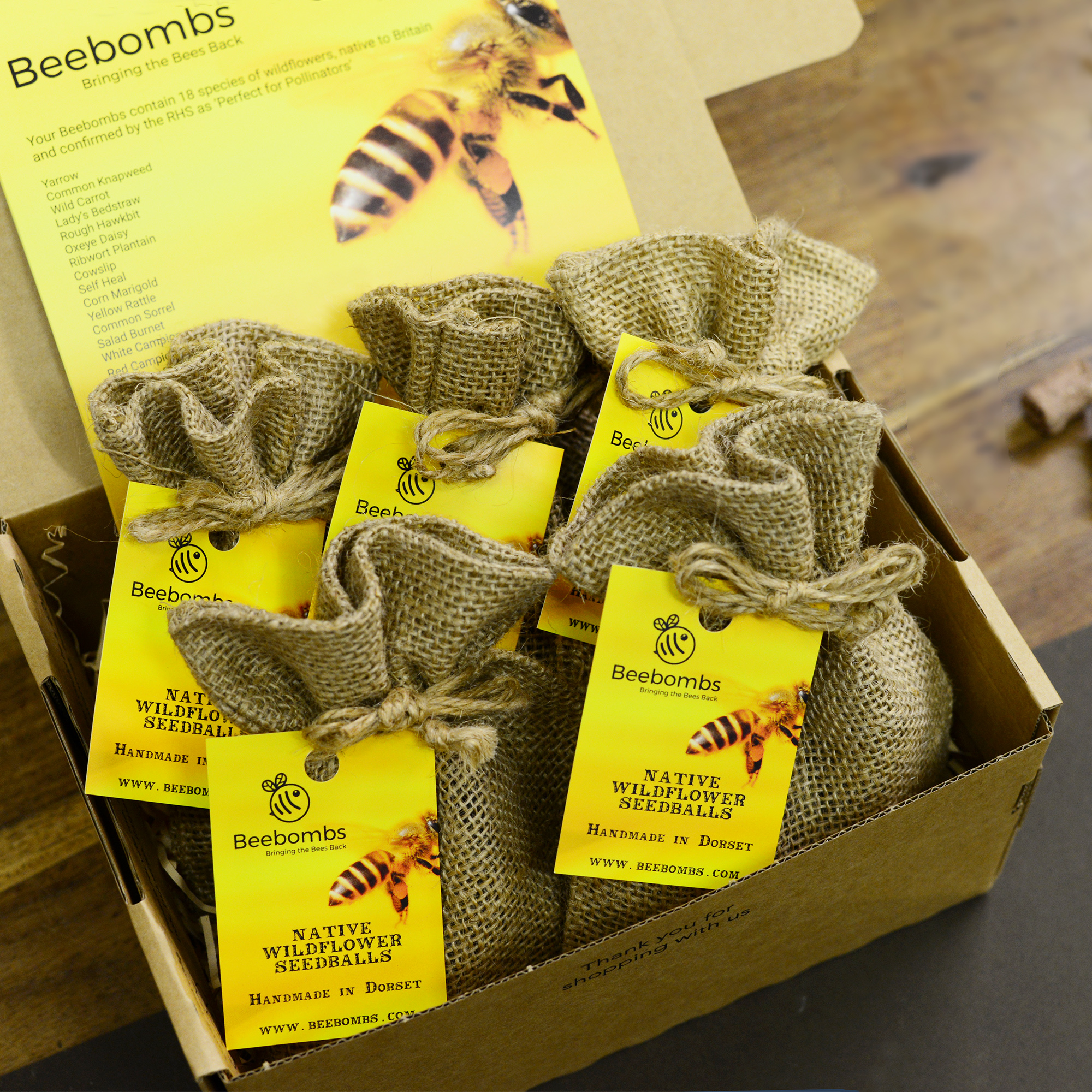
5 packs of handmade, native wildflower Beebombs. 1000s of seeds from 18 native wildflower species, mixed with local protective clay and sifted, nurturing top soil. 5 packs provides coverage for roughly 105 sq ft / 10m² of wildflower meadow.
Beebombs are a mix of annuals and perennial species, providing natural and diverse habitat. They’re specially designed to help support your local pollinators and provide a long flowering season, rich in colour and vibrancy.
Using seedballs protects the seeds from predators and provides a nurturing environment for the seeds to germinate from, making it easier for you to create the wildflower habitat Britain needs.
We use no plastic in our packaging or process and make your Beebombs in a truly sustainable and traditional way on our farm in Parley, Dorset.
Free tracked postage and packing on all orders, Dispatched same day (before 12pm) via Royal Mail Tracked 48 service, to anywhere in the UK.
Next day delivery also available.

10 packs of handmade, native wildflower Beebombs. 1000s of seeds from 18 native wildflower species, mixed with local protective clay and sifted, nurturing top soil. 10 packs provides coverage for roughly 210 sq ft, / 20 m² of wildflower meadow
Beebombs are a mix of annuals and perennial species, providing natural and diverse habitat. They’re specially designed to help support your local pollinators and provide a long flowering season, rich in colour and vibrancy.
Using seedballs protects the seeds from predators and provides a nurturing environment for the seeds to germinate from, making it easier for you to create the wildflower habitat Britain needs.
We use no plastic in our packaging or process and make your Beebombs in a truly sustainable and traditional way on our farm in Parley, Dorset.
Free tracked postage and packing on all orders, Dispatched same day (before 12pm) via Royal Mail Tracked 48 service, to anywhere in the UK.
Next day delivery also available.