
The Dark-Winged Blood Bee: Nature's Sneaky Squatter
Imagine a world where home invasion is a way of life. Welcome to the fascinating realm ofSphecodes gibbus, commonly known as the dark-winged blood bee. Don't worry, these little critters aren't out for your blood – their name comes from their striking red and black coloration.
A Bee of Many Names
First described by Carl Linnaeus in 1758, this sneaky bee has gone through quite the identity crisis. It's been known asSphex gibba,Sphecodes picea, and evenSphecodes sphecoides. But let's stick withSphecodes gibbus– it rolls off the tongue, doesn’t it?
The Art of Breaking and Entering
Now, you might be wondering what makes this bee so special. Well, hold onto your hive because Sphecodes gibbus is a master of deception. These bees are cleptoparasites, which is a fancy way of saying they're the ultimate squatters of the insect world.Here's how it works:
Find a suitable host nest (usually belonging to larger bees like Halictus or Lasioglossum)
Wait for the homeowner to step out
Sneak in and replace the host's egg with their own
Profit!
It's like the insect version of switching out someone's homemade lunch with a ready meal. Not very neighbourly, but you've got to admire their audacity!
Distribution in the UK
Sphecodes gibbusis widely distributed throughout Britain, reaching as far north as southern Scotland. However, it has not been recorded in Ireland. This bee is often seen in a variety of habitats, although it prefers warmer, open areas with some bare ground, which is essential for its nesting behaviour.
Ideal Habitats
You are most likely to encounterSphecodes gibbusin:
Open Areas: Look for them in fields, gardens, and parks with exposed soil or sandy banks.
Bare Ground: These bees are often found flying over areas with bare ground as they search for the nests of their host species, which include larger bees from the genera Halictus and Lasioglossum.
Floral Diversity: They are attracted to a wide range of flowers, particularly those from the Asteraceae (daisy) and Apiaceae (carrot) families, so gardens with diverse flowering plants can be a good spot to observe them.
Seasonal Activity
In the UK, femaleSphecodes gibbuscan be found from April to September, with males appearing from July to September. Early in the season, females are busy searching for host nests to parasitise, while later in the season, they focus on finding mates and suitable overwintering sites.
Notable Locations
While specific records are sparse, there have been sightings in various regions, including:
Nottinghamshire: Recent records have been noted in places like Attenborough Nature Reserve and Oak Tree Heath.
Essex: The Essex Field Club has documented occurrences, indicating that this bee can be found in various habitats across the county.
General Areas: They are often spotted in urban and rural settings alike, as long as the conditions are right.
In summary, if you're keen on spotting the dark-winged blood bee, head to open, sunny areas with some bare ground and a variety of flowering plants, especially during their active months from April to September. Happy bee watching!


1 pack of handmade, native wildflower Beebombs. 1000s of seeds from 18 native wildflower species, mixed with local protective clay and sifted, nurturing top soil. 1 pack provides coverage for roughly 21 sq ft / 2m² of wildflower meadow.
Beebombs are a mix of annuals and perennial species, providing natural and diverse habitat. They’re specially designed to help support your local pollinators and provide a long flowering season, rich in colour and vibrancy.
Using seedballs protects the seeds from predators and provides a nurturing environment for the seeds to germinate from, making it easier for you to create the wildflower habitat Britain needs.
We use no plastic in our packaging or process and make your Beebombs in a truly sustainable and traditional way on our farm in Parley, Dorset.
Free tracked postage and packing on all orders, Dispatched same day (before 12pm) via Royal Mail Tracked 48 service, to anywhere in the UK.
Next day delivery also available.
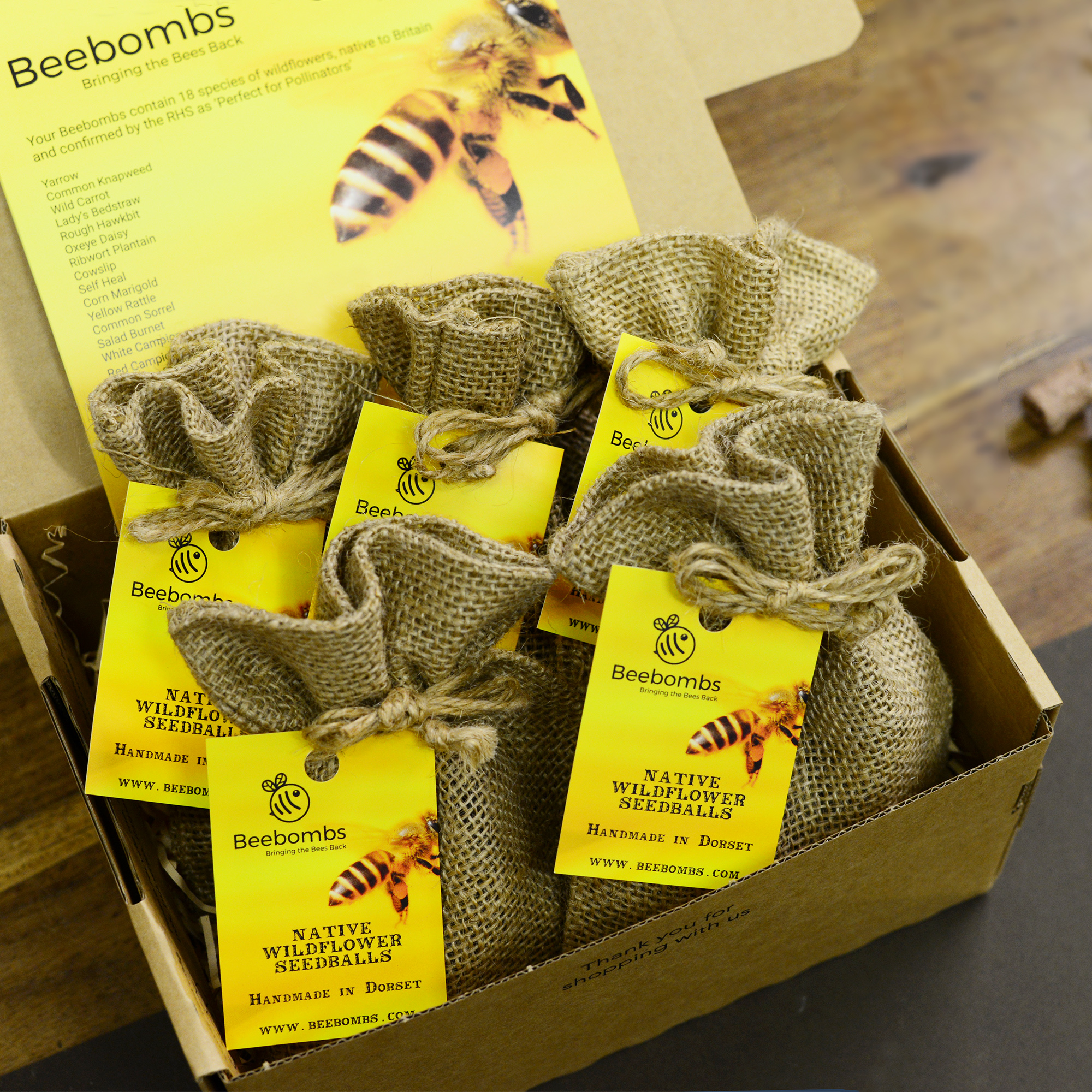
5 packs of handmade, native wildflower Beebombs. 1000s of seeds from 18 native wildflower species, mixed with local protective clay and sifted, nurturing top soil. 5 packs provides coverage for roughly 105 sq ft / 10m² of wildflower meadow.
Beebombs are a mix of annuals and perennial species, providing natural and diverse habitat. They’re specially designed to help support your local pollinators and provide a long flowering season, rich in colour and vibrancy.
Using seedballs protects the seeds from predators and provides a nurturing environment for the seeds to germinate from, making it easier for you to create the wildflower habitat Britain needs.
We use no plastic in our packaging or process and make your Beebombs in a truly sustainable and traditional way on our farm in Parley, Dorset.
Free tracked postage and packing on all orders, Dispatched same day (before 12pm) via Royal Mail Tracked 48 service, to anywhere in the UK.
Next day delivery also available.